Thursday, 18 December 2014

Preliminary Exercise Evalution

In our preliminary task, our story was a about a boy named Taju going in for an interview at JD. However, when he is approached by one of the managers at JD, who happens to be me- his approach is very unprofessional and ends up getting thrown out of the interview!

It stars me and Taju Deen and was filmed by Ebun Awosiyan


At the start of the scene, we used match on action at 0.01-0.15 as we see Taju looking at his iPhone, and then we see the recruitment poster of JD, which is white and also looks similar to Tajus white screen on his phone. This is effective because it makes the viewer more interesting to watch as it is a nice effect.

We used the Eye line match as Taju walks along the corridor and sees JD's recruitment poster. 0.10-016. In this scene you see Taju walking along the corridor looking at his phone, but the suddenly looks up to look at something, which the audience do not know what he is looking at yet until we get a close up of what Taju is looking at which is the JD recruitment poster.

We then used the shot reverse shot constantly  during the interview with myself and Taju. 0.43-1.10. This is used because it shows two characters looking at each other, one character is looking at the other character off screen. This is effective because it makes it appear as if each character is looking back and forth at one another.

We also followed the 180 degree rule at all times while filming our exercise, however we made sure we conducted this very well during the interview between myself and Taju, which is why we choose to film it right at the back of the class room and not in the middle in order to avoid confusion. We also conducted our shot reverse shot accurately and stuck to the 180 degree rule. However I believe there was room for improvement with filming our shot reverse shot.

Additionally, I believe that we were able to include all the techniques we needed and also conduct a well understandable story line which made sense to everyone who viewed it. However I feel we could have definitely had time to improve the interview position and added a few more shots of the interview from different angles and techniques.


Monday, 8 December 2014

Editing Introduction


Editing is the process of looking at all the footage shot during the making of a film/TV programme and placing it in the desired order and joining it together.

Two key areas to concentrate on when editing are;

1. Speed of editing- how long does each shot last.
2. Style of editing- how each shot is joined together to the next?

The speed of editing will help to determine the mood of whats taking place on screen.
If the audience feels anxiety and suspense the editing will be quick- the scenes/shots will change frequently. For example in an action sequence.

As the film progresses scenes may become shorter as the editing cuts between telling two or more story lines at the same time.

It is important to consider;

1.How quickly or slow the shot appears as sequences

2. How long they appear on the screen for.


Style of Editing

- How shots are linked together.
- The movement from one shot to the next is called a transition.


Straight Cut

- Most common and "invisible" form of transitions.
- One shot moves in spontaneously to the next without attracting the audiences attention.
 Straight cuts help retain reality. They do not break the viewers suspension of disbelief.


Dissolves

-Fading on shot off the screen while another shot is fading in

- The audience will be able to see both shots on the screen on the mid-point of the dissolve.

- Used if the film maker wants to show a connection between two characters, places or objects.

Fades

- A gradual darkening of lightening of an image until it becomes black or white.

- One shot will fade until only a black or white screen can be seen.

- used to indicate the end of a particular section of time within the narrative.

- can show the passing of time

Wipes

-One image is pushed off the screen by another

- images can be pushed left or right

- used to signal a movement between different locations that are experiencing at the same time.

Jump Cut
- a jump cut is where the audience's attention is brought into focus on something very sudden

- this occurs by breaking the continuity editing

-this is also known as discontinuity

- it appears as if a section of the sequence has been removed

- used to startle the view and to draw attention to something.

Friday, 5 December 2014

Continuity Editing


Continuity Editing is a style of editing. It ensures that editing follows and continues from one shot to the other. For example a shot of two people conversing and then a shot of a spaceship, this is not continuity editing as the two shots do not follow each other. The purpose is to smooth over discontinuity of the editing process and establish a logical process between two shots.

Continuity Editing is important because it allows the shots to be logical and easy to process and understand for the viewers. It is important because it also allows the editing to flow with the illusion that the action is continuous.

An example: 


Eyeline Match

Eyeline match is when we see a character looking at someone off screen and then we cut a shot of what they are looking at. It is based on premise that the audience will want to see what the character in-screen is seeing. It is associated with the continuity editing system.  


Match on Action

Match on Action is an editing technique used for continuity editing, in which one shot cuts to another. We see the characters start an action in one shot and then see them continue it in the next.


Shot/reverse shot

Shot reverse shot (or shot /countershot) is a film technique where one character is shown looking at another character (often off-screen), and then the other character is shown looking back at the first character. Additionally, the video shows high angle and low angle shots as the woman looks up at the man she is speaking to. 


180 Degree Rule

The 180 Degree Rule a basic guideline that states that two characters (or other elements) in the same scene should always have the same left/right relationship to each other. Some styles uses with the 180-degree rule can elicit an emotion or create a visual rhythm. By moving the camera closer to the axis for a close-up shot, it can intensify a scene when paired with a long shot.


Graphic Match

The graphic match is when two shots are linked with a similar shape or composition of an image. e.g the shower scene in Psycho.


Wednesday, 3 December 2014

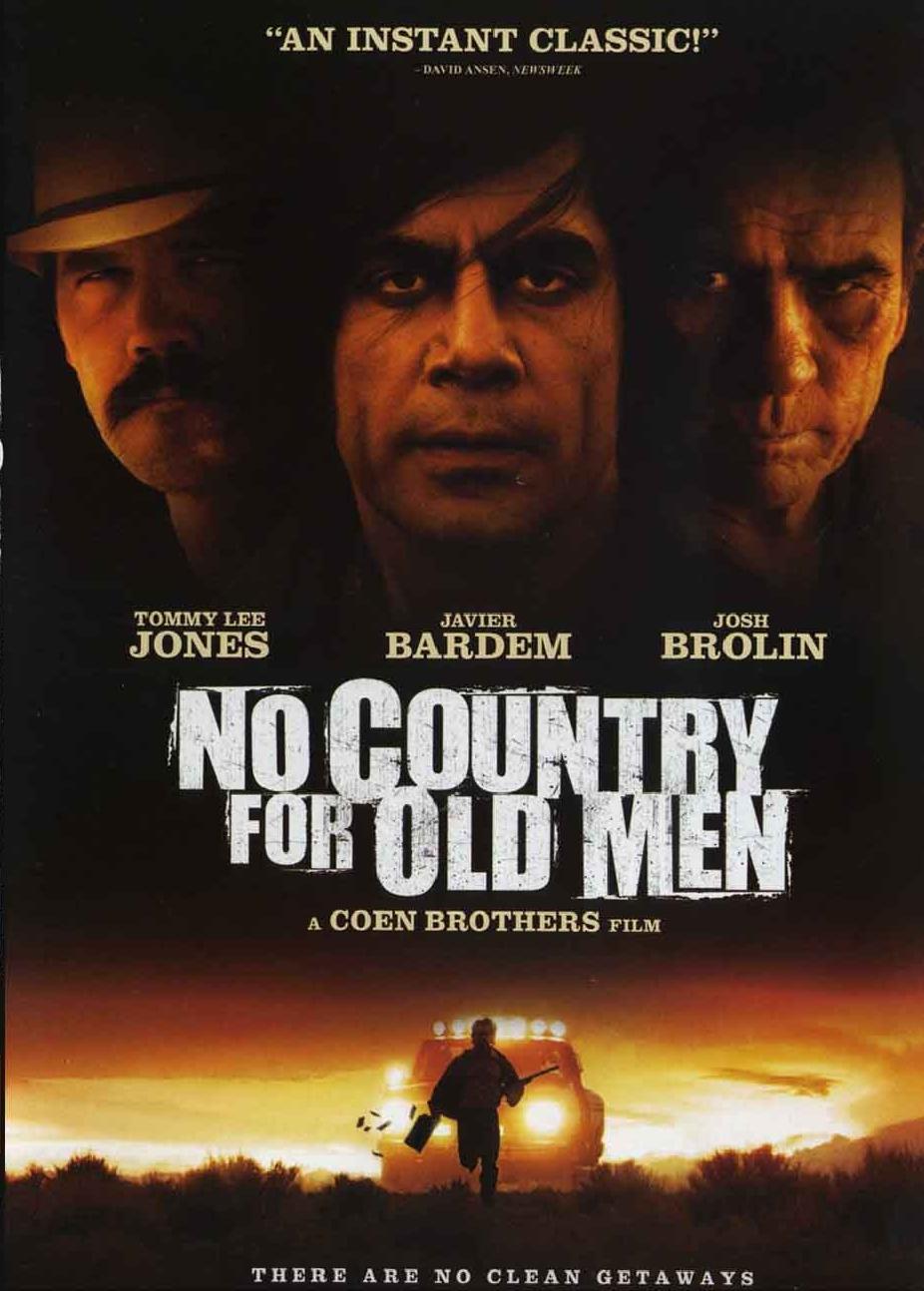
No Country for Old men (Opening Scene)


No Country For Old Men was directed by Ethan Coen and Joel Coen in 2007 and is an American neo-Western thriller. It started Tommy Lee Jones, Javier Bardem and Josh Brolin.  It is a story of an ordinary man to whom chance delivers a fortune that is not his, and the ensuring cat-and-mouse drama.  The film had a budget of $25 million and made $171.6 million at box office.

https://www.youtube.com/watch?v=V_6mFcTGXh0- 'No Country For Old Men' Trailer. My analysis is going to be until 4.30

Sound

As the film starts we hear a non-diegetic sound as It is not in the world of the text and is a voice over of a man telling us his story/information. This builds up tension as we are not aware of what may happen next and what the film will be about. As we get familiar to the surroundings we hear creepy music as the sound track which is also non-diegetic as the man is still talking we infers to us that something bad has happened or is going to happen. The next scene we hear the police officer on the phone to another police officer, this is diegetic sound as the characters can see and hear the source of the sound. 


Editing

The editing starts with a slow build up, Shows us different cuts of the country side, the mountains, grass, the sky which paints a picture and gets us familiar to the surroundings. The editing starts off slow so that we can grasp our surroundings and it prepares us for the next scene which is much faster and more graphic. Once we get into the next scene, the editing becomes much more faster and their are more cuts. As we get to the part where the arrested man strangles the police officer, the cuts are slightly dragged out which may suggest to horrifying nature of the crime and to understand what kind of disgusting man the character is. 


Miss en scene

As the film starts we only see power lines, and the sky, the country side, grass, mountains . As we cannot see anyone, it creates a sense of isolation as the area is deserted and alone. As we reach two minutes of views of the country side we and no characters, we finally see a policeman arresting a man and getting into the police car. As we start the next scene we see the police man on the phone to another police officer and the man who got arrested in the back,however he is blurred out. Slowly we see the arrested man getting up and putting his legs over him arms so that his hands are in front of him, which creates suspense as the viewers stay wondering what is going to happen next. The fact that the room is dark and gloomy creates a dull effect on the viewers as it shows the isolation of the scene.  As we see the man getting closer to the police officer, it creates a sense of fear, as the man has just been arrested meaning he has committed a crime and is a criminal. The fact that the man has his hands in front of him and walks up to the police officer suggests he may commit another crime. 


Camera

As the film starts we a long shot of the sky, mountains and grass.  We then get a sudden rolling shot and then we see a police car, and the police officer and an arrested man getting into the police car, this creates wonder as what the man did to get arrested and who the characters are. As the police officer puts the man into the car we get a close up of the gas that the police officer puts in the front seat, this tells us that the gas has had some meaning in the film and may continue to have greater meaning and could have been used for something important. As we approach the next screen we get a medium shot of the police officer and the man, however the camera starts to get closer and closer as we see the man getting up and getting closer to the police officer which creates suspense and tension as we wonder what is going to happen next or what the man may do. We then get close ups and birds eye view shots of the man strangling the police officer.