Thursday, 18 December 2014

Preliminary Exercise Evalution

In our preliminary task, our story was a about a boy named Taju going in for an interview at JD. However, when he is approached by one of the managers at JD, who happens to be me- his approach is very unprofessional and ends up getting thrown out of the interview!

It stars me and Taju Deen and was filmed by Ebun Awosiyan


At the start of the scene, we used match on action at 0.01-0.15 as we see Taju looking at his iPhone, and then we see the recruitment poster of JD, which is white and also looks similar to Tajus white screen on his phone. This is effective because it makes the viewer more interesting to watch as it is a nice effect.

We used the Eye line match as Taju walks along the corridor and sees JD's recruitment poster. 0.10-016. In this scene you see Taju walking along the corridor looking at his phone, but the suddenly looks up to look at something, which the audience do not know what he is looking at yet until we get a close up of what Taju is looking at which is the JD recruitment poster.

We then used the shot reverse shot constantly  during the interview with myself and Taju. 0.43-1.10. This is used because it shows two characters looking at each other, one character is looking at the other character off screen. This is effective because it makes it appear as if each character is looking back and forth at one another.

We also followed the 180 degree rule at all times while filming our exercise, however we made sure we conducted this very well during the interview between myself and Taju, which is why we choose to film it right at the back of the class room and not in the middle in order to avoid confusion. We also conducted our shot reverse shot accurately and stuck to the 180 degree rule. However I believe there was room for improvement with filming our shot reverse shot.

Additionally, I believe that we were able to include all the techniques we needed and also conduct a well understandable story line which made sense to everyone who viewed it. However I feel we could have definitely had time to improve the interview position and added a few more shots of the interview from different angles and techniques.


Monday, 8 December 2014

Editing Introduction


Editing is the process of looking at all the footage shot during the making of a film/TV programme and placing it in the desired order and joining it together.

Two key areas to concentrate on when editing are;

1. Speed of editing- how long does each shot last.
2. Style of editing- how each shot is joined together to the next?

The speed of editing will help to determine the mood of whats taking place on screen.
If the audience feels anxiety and suspense the editing will be quick- the scenes/shots will change frequently. For example in an action sequence.

As the film progresses scenes may become shorter as the editing cuts between telling two or more story lines at the same time.

It is important to consider;

1.How quickly or slow the shot appears as sequences

2. How long they appear on the screen for.


Style of Editing

- How shots are linked together.
- The movement from one shot to the next is called a transition.


Straight Cut

- Most common and "invisible" form of transitions.
- One shot moves in spontaneously to the next without attracting the audiences attention.
 Straight cuts help retain reality. They do not break the viewers suspension of disbelief.


Dissolves

-Fading on shot off the screen while another shot is fading in

- The audience will be able to see both shots on the screen on the mid-point of the dissolve.

- Used if the film maker wants to show a connection between two characters, places or objects.

Fades

- A gradual darkening of lightening of an image until it becomes black or white.

- One shot will fade until only a black or white screen can be seen.

- used to indicate the end of a particular section of time within the narrative.

- can show the passing of time

Wipes

-One image is pushed off the screen by another

- images can be pushed left or right

- used to signal a movement between different locations that are experiencing at the same time.

Jump Cut
- a jump cut is where the audience's attention is brought into focus on something very sudden

- this occurs by breaking the continuity editing

-this is also known as discontinuity

- it appears as if a section of the sequence has been removed

- used to startle the view and to draw attention to something.

Friday, 5 December 2014

Continuity Editing


Continuity Editing is a style of editing. It ensures that editing follows and continues from one shot to the other. For example a shot of two people conversing and then a shot of a spaceship, this is not continuity editing as the two shots do not follow each other. The purpose is to smooth over discontinuity of the editing process and establish a logical process between two shots.

Continuity Editing is important because it allows the shots to be logical and easy to process and understand for the viewers. It is important because it also allows the editing to flow with the illusion that the action is continuous.

An example: 


Eyeline Match

Eyeline match is when we see a character looking at someone off screen and then we cut a shot of what they are looking at. It is based on premise that the audience will want to see what the character in-screen is seeing. It is associated with the continuity editing system.  


Match on Action

Match on Action is an editing technique used for continuity editing, in which one shot cuts to another. We see the characters start an action in one shot and then see them continue it in the next.


Shot/reverse shot

Shot reverse shot (or shot /countershot) is a film technique where one character is shown looking at another character (often off-screen), and then the other character is shown looking back at the first character. Additionally, the video shows high angle and low angle shots as the woman looks up at the man she is speaking to. 


180 Degree Rule

The 180 Degree Rule a basic guideline that states that two characters (or other elements) in the same scene should always have the same left/right relationship to each other. Some styles uses with the 180-degree rule can elicit an emotion or create a visual rhythm. By moving the camera closer to the axis for a close-up shot, it can intensify a scene when paired with a long shot.


Graphic Match

The graphic match is when two shots are linked with a similar shape or composition of an image. e.g the shower scene in Psycho.


Wednesday, 3 December 2014

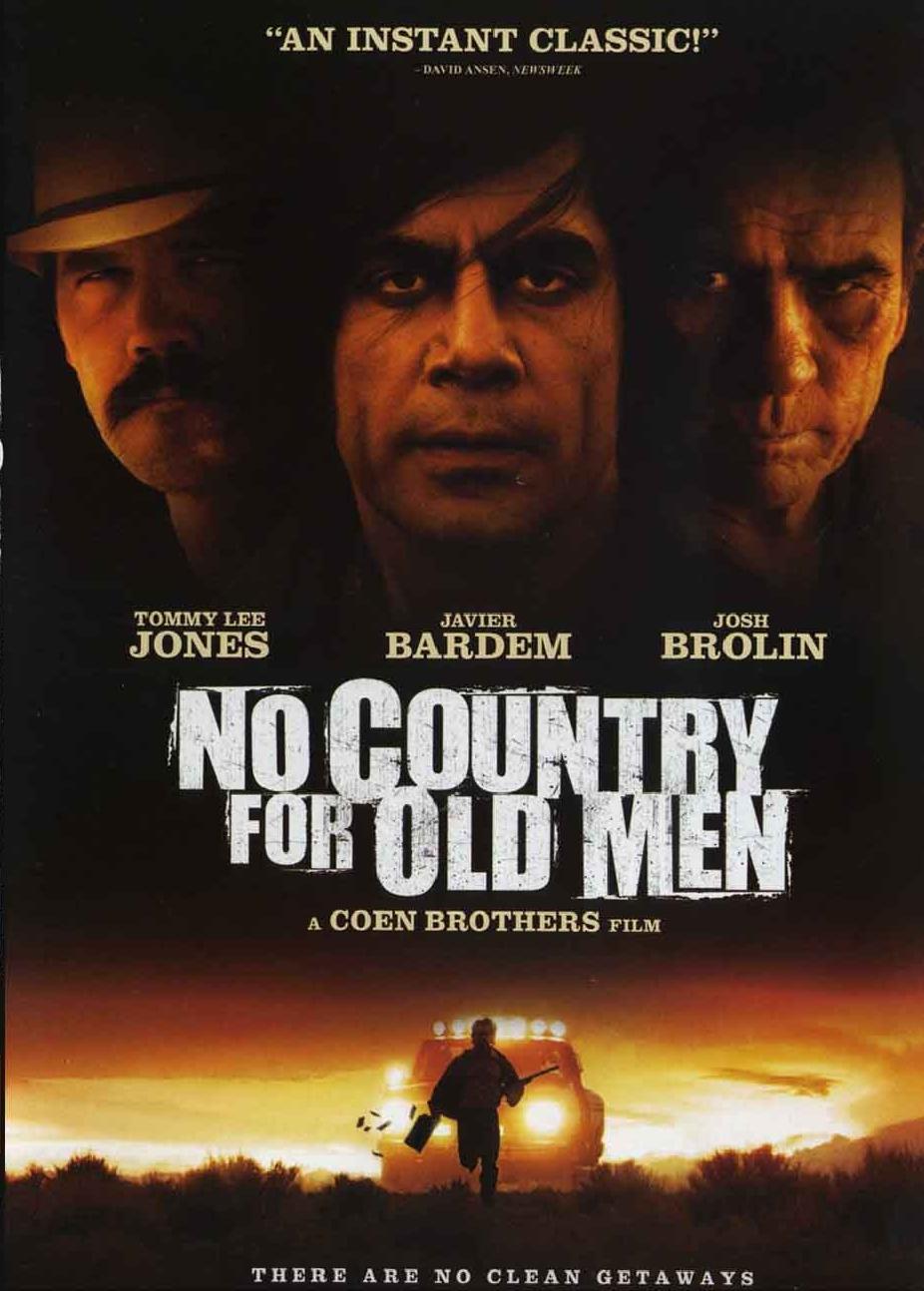
No Country for Old men (Opening Scene)


No Country For Old Men was directed by Ethan Coen and Joel Coen in 2007 and is an American neo-Western thriller. It started Tommy Lee Jones, Javier Bardem and Josh Brolin.  It is a story of an ordinary man to whom chance delivers a fortune that is not his, and the ensuring cat-and-mouse drama.  The film had a budget of $25 million and made $171.6 million at box office.

https://www.youtube.com/watch?v=V_6mFcTGXh0- 'No Country For Old Men' Trailer. My analysis is going to be until 4.30

Sound

As the film starts we hear a non-diegetic sound as It is not in the world of the text and is a voice over of a man telling us his story/information. This builds up tension as we are not aware of what may happen next and what the film will be about. As we get familiar to the surroundings we hear creepy music as the sound track which is also non-diegetic as the man is still talking we infers to us that something bad has happened or is going to happen. The next scene we hear the police officer on the phone to another police officer, this is diegetic sound as the characters can see and hear the source of the sound. 


Editing

The editing starts with a slow build up, Shows us different cuts of the country side, the mountains, grass, the sky which paints a picture and gets us familiar to the surroundings. The editing starts off slow so that we can grasp our surroundings and it prepares us for the next scene which is much faster and more graphic. Once we get into the next scene, the editing becomes much more faster and their are more cuts. As we get to the part where the arrested man strangles the police officer, the cuts are slightly dragged out which may suggest to horrifying nature of the crime and to understand what kind of disgusting man the character is. 


Miss en scene

As the film starts we only see power lines, and the sky, the country side, grass, mountains . As we cannot see anyone, it creates a sense of isolation as the area is deserted and alone. As we reach two minutes of views of the country side we and no characters, we finally see a policeman arresting a man and getting into the police car. As we start the next scene we see the police man on the phone to another police officer and the man who got arrested in the back,however he is blurred out. Slowly we see the arrested man getting up and putting his legs over him arms so that his hands are in front of him, which creates suspense as the viewers stay wondering what is going to happen next. The fact that the room is dark and gloomy creates a dull effect on the viewers as it shows the isolation of the scene.  As we see the man getting closer to the police officer, it creates a sense of fear, as the man has just been arrested meaning he has committed a crime and is a criminal. The fact that the man has his hands in front of him and walks up to the police officer suggests he may commit another crime. 


Camera

As the film starts we a long shot of the sky, mountains and grass.  We then get a sudden rolling shot and then we see a police car, and the police officer and an arrested man getting into the police car, this creates wonder as what the man did to get arrested and who the characters are. As the police officer puts the man into the car we get a close up of the gas that the police officer puts in the front seat, this tells us that the gas has had some meaning in the film and may continue to have greater meaning and could have been used for something important. As we approach the next screen we get a medium shot of the police officer and the man, however the camera starts to get closer and closer as we see the man getting up and getting closer to the police officer which creates suspense and tension as we wonder what is going to happen next or what the man may do. We then get close ups and birds eye view shots of the man strangling the police officer.


Monday, 24 November 2014

The opening scene of 'A History Of Violence'


A History Of Violence is a thriller of a mild-mannered man who becomes a local hero through an act of violence which sets off repercussions that will shake his family to its very core. It was directed by David Cronenberg and written by John Wagner and Vince Locke. It was staring Viggo Mortensen, Maria Bello and Ed Harris.


http://zumvo.com/watch-a-history-of-violence-2005-4396 This is the full movie of A history of Violence however i am only going to be analyzing until 6:03.

Miss En Scene

The opening scene starts off as a long build up, there are no cuts in the first scene so we can get an idea of who the characters are. The surroundings are quiet and deserted which shows the isolation, this also creates mystery and suspense. As we get a look at the characters we see two ordinary men come out of a house one dressed smart/casual and one casual. The man in the white top then smokes his cigarette and puts the chair outside straight, this could suggest that their may have been some altercation which caused the chair to be out of position. It is set near a motel which causes suspicion  as to what they are doing there. In addition the feature of motels in a film create suspense as they are usually the site to danger. As we get into the house we see it is run down and suggests that they may not have a lot of money, the slow movements on the man also suggests suspicion as looks uncomfortable to be there.

Camera Work

The scene starts with a medium shot and then a tracking shot on the man with the white top which indicates his importance as a character. One the two men get to the blue car the camera does not change its angle and is positioned directly at them. This suggests that the director wants us to pay attention to the characters and their body language and study their characters. As the man in the white top gets out of the car we get a close up of him, this is to get to know him and see what he looks like, which also shows his importance. As we go inside of the house we see blood which leaves the audience wondering who's blood it is and then we see a dead body. This then cuts and we get a shot of the man which suggests his involvement. We then get a mediums shot of a girl holding her doll crying which makes us feel sorry for the girl as she is alone and looks vulnerable and we know that something terrible has happened to someone close to her. The camera angle then changes and we get a low angle shot of the man which makes him look powerful and dominate. As he gets down to her level the viewers are wondering if he is going to be kind to her but as we get a shot of the gun we know all hope is lost and he is going to murder her. Lastly, the extreme close up of the gun shows mass control and power the gun has over everything in the room.


Sound

At the start of the scene we hear diegetic sound of nature and then we hear dialogue from the characters which makes us get to know the characters and their personalities. As the man in the white top is left in the car alone he places diegetic happy country music which calms the audience down from the quiet tense atmosphere but however also may convey that the character is calming himself down from whatever he has on his mind as he also looks distressed.  The director uses a sound bridge as the nature sound carries on into the next scene and becomes louder which shows tension. As we enter the house we hear creepy music and the see the blood and the dead body, which creates enigma as it leaves us wondering who's body it is and if the characters have committed murder. As the creepy music continues as we leave the dead body it conveys that something bad is going to happen next. The soundtrack is non-diegetic. As we continue this scene we see a little girl come out of the room crying holding a doll, this is diegetic sound as the character can see the source of the sound. The character then acts on this and we as we hear the gun shot.


Editing

The opening scene is 2-4 minutes long so we can really get to know the characters which portrays the slow build up of editing. The first cut was in the house and the cuts gradually become faster and faster as we got deeper into the house. There was a total of 12 cuts which all took place in the house,  demonstrating the house's creepy atmosphere and tension and build up of suspense.


Monday, 10 November 2014

Unknown

  Director : Jaume Collet-Serra
Written by: Oliver Butcher and Stephan Cornwell

The budget of the film was estimated around $30,000,000 and they made a gross profit of $130,786,397

The poster shows us a modern thriller poster, with Liam Neeson on the front- This will attract people to watch it as they now know he will be starring in it as he is a big actor. The poster is plan with a few words saying "TAKE BACK YOUR LIFE", however as Liam Neeson is on the front this will attract people to watch it and find out what it is about. Additionally, because it is plan it will attract people to watch the trailer.

Unknown is a film about a man who awakens from a coma, only to discover that someone has taken on his identity and that no one believes him. However, with the help of a young woman he sets out to prove who he is, in the end we find out that the man he believed to be doesn't exist and he had remembered the wrong life. We discover that he is an assassin but had remembered the wrong identity, as the car crash caused it.


http://www.youtube.com/watch?v=I-lDfKb2SBA - trailer

The trailer starts with showing us Liam Neeson on an aeroplane on his way to Berlin. It then jumps straight into showing us him in hospital telling us he has been in a coma for 4 days. This grabs the audience attention because the audience want to know how he got himself into the coma and what will happen next. It contains typical elements of a thriller such as, suspense which we see Liam Neeson going towards his wife and then she claims she doesn't know who he is. Followed by another man appearing and claiming to be Dr Martin Harris. It also contains tension and excitement as we see the car crash into the water. It is constructed in a way that makes the audience on edge and want to go and watch the film, as it shows us some of the key scenes, which build tension and suspense.


Key Tension Scenes

In Unknown there are essential characteristics of a good thriller, these include moments of high tension. An example of this is the hospital scene, where Liam goes to reach for the scissors leading to murder.          http://www.putlocker.tw/watch-unknown-online-free-putlocker-2011.html  - from 20 minutes.  

This scene builds tension in a numerous amount of ways. One of these ways are the use of close ups on the scissors and the murder. It gets the audience wondering whether he is going to reach for the scissors in time before the other man comes back into the room. Another way this scene builds tension is through the soundtrack. As Dr Martin Harris is escaping the sound track becomes louder and faster with the use of disorientating sounds to convey the adrenaline going through us and the characters, as does the editing become faster to show how intense the scene is. Our hearts beat faster because we want Dr Harris to escape quickly as possible, however the other man has noticed he has escaped and is after him.


The Club Scene 
http://www.putlocker.tw/watch-unknown-online-free-putlocker-2011.html - From 63 minutes

The club scene is effective with tension because it uses a loud booming soundtrack which is disorientating and threatening to the audience as we do not know what anyone else is saying and anything could happen at any time. The use of a dark screen which only shows shadows is indistinct and allows the audience to share the same confusion as the main character, as like them we also do not know who will appear at any moment or if they are still being chased or if they have lost them, as they could be lurking in the darkness.


The McGuffin 

In Unknown the mcguffin is Prince Shalla and the world food, which provides the basis of the story, however the audience are drawn away from this and they are only interested in Liam Neeson's character and finding out if he is truly Dr Martin Harris and what exactly is going on.


The Car Chase 

http://www.imdb.com/title/tt1401152/ - The first clip below

   This scene is effective because it starts of with fast editing speed, this gets the audience at edge as they try to keep up with what is happening in the chase The speed of the editing is also effective because it makes the audience aware that anything can happen next. As we see them heading towards the train the sound becomes more fast pacing which suites the actions in the screen, this tells the audience that they could crash into the train or something disastrous is about to happen. The lightening in this scene reminds dark throughout to portray the danger and high risk that the characters are in. This also creates a doomy mood and scary atmosphere as we cannot see too clearly. The camera angle in the scene remains at a close up in the car to show the fear in the characters and desperate they are to escape.

Thriller Conventions - Vladimir Propp

In Unknown The helper and princess is Gina who is side by side with Dr Martin Harris and helps him rediscover his identity again.


It is also a polysemic text as he discovers that he was never truly Dr. Martin Harris and is actually Henry Taylor, who is an ordinary man. However we do not know what he goes off to do with his life in the end. It can have many different meanings as he could live his life with Gina or he can go back to being ordinary and doing his own thing.


Tuesday, 4 November 2014

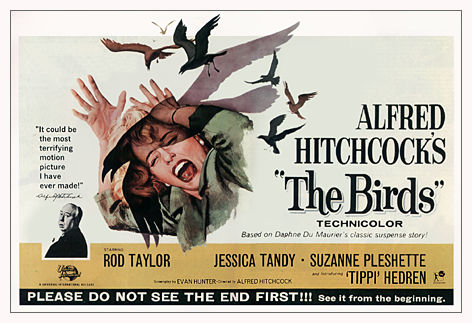
The Birds By Alfred Hitchcock


 "The Birds" by Alfred Hitchcock

"The Birds" by Alfred Hitchcock was made in 1963. The story of the film was written by Evan Hunter. Htchcock told him to develop new characters and a more elaborate plot keeping du Maurier's title. It stared Rob Taylor, Tippi Hendren and Suzanne Pleshette. It was made in the United States of America and sold $11,403,529 at Box office.

It depicts Bodega Bay, California, which is, suddenly and for unexplained reasons, the subject of a series of widespread and violent bird attacks over the course of a few days.


https://www.youtube.com/watch?v=mPC_Mp0Y9WM- " The Birds" Trailer

The trailer is effective because is shows a few interesting parts of the movie without giving away the whole story plot. It also grabs the viewers attention which makes people want to go and watch the film. It contacts the typical aspects of a thriller such as a talk over,and a few clips from the movie. It appeals to its audience by staying within the limits of the rules and working around them where possible. The audience's imagination was a great help to Hitchcock ad he triggered it in the end scene when Mitch goes outside to the garage.
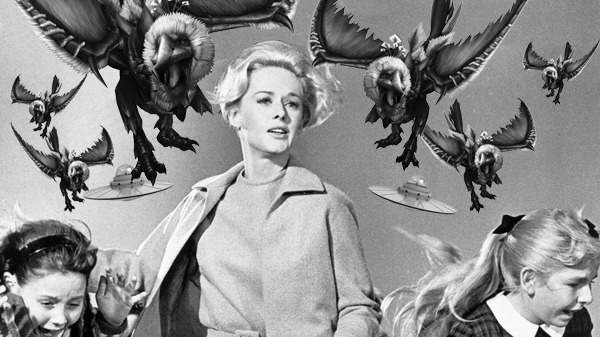
"The Birds"


- The external threat if from nature. Often in Hitchcock there is nowhere to hide e.g. Bodega Bay, the birds attack from everywhere and anywhere. Whether being inside or outside. Hitchcock wanted to express how terrifying it was, to build tension and suspense. 
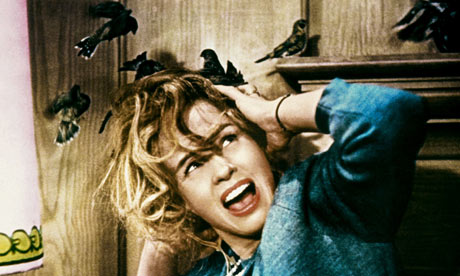
 Thrillers are characterized by fast pacing, frequent action and a resourceful hero who must thwart the plans of a villain or threat.

An example of fast pacing in "The Birds" is when the crows one by one start to come on the playgroundhttps://www.youtube.com/watch?v=ydLJtKlVVZw&list=PL46FB178E8BEABAB8&index=5

This scene creates fast pacing as the audience first start off in a calm mood watching Miss Daniels smoking and listening to the children singing. However the fast pacing starts as we get a medium shot of Melanie and then a Master shot of point of view shot of Melanie looking at the birds. The birds start off at 4 and gradually become a greater number one by one. The audience are now in suspense at what is going to happen next, which is where we get a tracking shot of a bird flying in the air by its self, we assume it may be flying over to attack Melanie. However the bird comes to the rest of the birds where we see there are now hundreds and hundreds. The audience are now in awe and are scared at what may happen next. It shows how each round of song that the children are singing, adds another measure symbolizing the multiplying birds.

The Gas Scene- https://www.youtube.com/watch?v=5-HYj5cLfEI 

In this scene the fast pacing starts to build as we witness a man being attacked by a bird,from there the fast pacing starts to build as we are left to wonder if this will start off an attack of hundreds of more birds. The characters start to brace themselves for what will happen next, while some go outside to help. We then get a shot of the gas leaking onto the road and then back at the characters. We then a shot of Melanie and then a POV shot of her watching the gas flow until it reaches a car. We are left in suspense for a few seconds, however the worrying look on Melanie's face and the camera angles suggest the worst to come. A man steps outside of the car and goes to light a cigar, which enlightens e Melanie, she then warns everyone to look at his as he lights his cigar so close to the gas which startles everyone and makes them yell at him to be careful. However the man is unaware of what is going on and drops his cigar which causes a massive explosion. Towards the end of the scene we see the birds fly to the scene one by one. The audience know that they are going to become frantic and result in another attack.


Thriller Conventions

In the Birds the highly powerful villains are The Birds which is unusual as they normally seem to be human. Additionally their are no heroes as the birds are more powerful than the humans and there are hundreds more of them than there is of the humans.


Suspense is used extensively throughout 'The Birds' an example of this is the eyes pecked out scene where Mrs.Brenner goes inside to visit Danny and finds his whole house in a state and him also dead in his own bedroom floor.


Eyes pecked out scene - https://www.youtube.com/watch?v=M0HjlCowwuM&feature=bf_prev&list=PL46FB178E8BEABAB8

This scene creates fast pacing because we see Mrs.Brenner walk into the house and we get a close up of the cups which are all broken, this creates confusion and the audience become more suspicious and creates fast pacing at what Mrs.Brenner may find. The lack of sound/sound over also creates fast pacing. As Mrs.Brenner walks into the bedroom and finds the windows smashed and in wretch. The audience are now a bit more settled as they think this is all that has happened and that they are going to find.

Another example of suspense in the birds is the ending scene.
The ending scene https://www.youtube.com/watch?v=qMwvHLe5m3g&index=11&list=PL46FB178E8BEABAB8

In the starting of this scene Mitch tries to get Melanie to the car to get her to the nearest hospital. As they open the door we see hundreds of birds outside everywhere. The fast tension then beginnings as we scared that the birds might attack again. Cathy then calls for Mitch to ask if she can bring the love birds with her, the audience are then scared and worried that this may startle the birds which can result in another attack.


Hitchcock technique

In the schoolyard scene the underlying score of the innocent child's song is in contrast to the evil in nature. Tippi Hendren's character is only guilty of taking nature for granted.In "TheBirds" scene outside the café- the high camera angle is like the gaze of pitiless God who cannot be bothered to intervene.  


"A thriller is a villain driven plot, whereby he presents obstacles the hero must overcome." 

In "The Birds" the MacGuffin is the sexual tension between Mitch and Melanie at the start and where Melanie pretends to be a shop assistant to get his attention. However in the end no one cares about the starting plot and are focused on why the birds are attacking, when will their next attack be and when they will stop.


Interesting Fact
"
- The scene where Tippi Hendren is ravaged by the birds near the end of the movie took a week to film.

- The birds were attached to her clothes by long nylon threads so they could not get away. 
- The film features 370 effect shots. The final shot is a composite of 32 separately filmed elements. 

- Tippi Hendren was actually cut in the face by a bird in one of the shots

- There is no musical score for the film expect for a shot electronic music sequence and the children singing in the school.

In my opinion the lack of non-diegetic sound helps the audience suspend disbelief and become more scared which creates tension and fast pacing.

Friday, 24 October 2014

Sound Exercise


.
This short video is based on two friends, but have now turned into enemies. Hayden had constantly borrowed Taju money, however every single time Taju had failed to pay him back. Hayden has had enough and is willing to do anything to get his money back from Taju.

We used a range of different sound techniques from diegetic and non diegetic sound, parallel sound, contrapuntal sound, on/off screen sound and also a sound bridge.

Diegetic & non diegetic sound : diegetic sound is sound in which comes from the story world, this includes a conversation or footsteps, although footsteps can be added in. The diegetic sound used in this exercise is the confrontation with Taju and Hayden. Conversely, non-diegetic sound is sound which has been added in for example a sound track or narrator (voice over) In the exercise we did not use any voice overs but I did use a sound track at the start which created a dramatic effect and warned us that something bad was going to happen.


Parallel/Contrapuntal Sound

Parallel sound is sound that matches the action. In the exercise we used parallel sound at 0:24 seconds where Hayden bumped into Taju. This matched the action because we could already tell Hayden was angry and the way he bumped into Taju was on purpose. We also used contrapuntal sound, this is the opposite to parallel sound, this is sound that doesn't match the action. In this exercise I used contrapuntal sound where Taju was walking along dancing and the sound was dark and scary, which reveals that something bad may happen to Taju, watching on it revealed that this was true.

On/Off Screen Sound

 On screen sound where sound occurs on screen, this can be either a conversation or something being dropped where the viewer can see the action happening. I used this at the point where the confrontation happened between Hayden and Taju. I also used off screen sound, again this is the opposite to on screen and this sound that comes from the world of the story however the audience cannot see where this is coming from.  I used off screen sound at  0:45- 1:20. It started off with foot steps, followed by dialling of a phone and then dialogue, the viewers can hear the source of the sound but cannot see it.


We were able to capture the sound effectively using a microphone which was positioned just above the camera, but not to far down so it came into the camera frame or shot, this was used in order to make sure that characters were heard effectively.

Some of the positive things we did well in this exercise was the on / off screen sound and the contrapuntal sound. However I feel there was needs for improvement with the sound bridge that was used. I also used a sound bridge at 0:44, the previous scene had footsteps of Taju and Hayden and it then carried on into the next scene which started off with footsteps of Taju running. However I believe that I could improve this feature to make it run more smoothly and editing it more precisely.


Tuesday, 14 October 2014

Rope by Alfred Hitchcock


Rope is a thriller made by Alfred Hitchcock in 1948. It stared some of the most famous actors of that time era. This included James Stewart, John Dall and Farley Granger.
- Background Information
Rope is adapted from Patrick Hamilton's 1929 play in which itself was said to be based on the grisly Leopold and Loeb case of 1924.  Nathan Leopold and Richard Leob were upper-class Chicago law students who murdered a teenage boy.
Like snobbish Brandon and Philip in Hitchcock's Rope film, the real-life murders considered themselves Nietzchean superman whose superiority of intellect exempted them from laws that govern the rest of us. 
An example of this is where Brandon claims; "Good and evil, right and wrong were invented for the ordinary average man, the inferior man, because he needs them," This shows his deluded mastermind of the murder, he had committed.  


Alfred Hitchcock- The director, was named "The Master of Suspense" and pioneered many techniques in the suspense and psychological thriller genres. He was born in August 13 1899 in Leytonstone, East London and died in April 29, 1980 in Bel-Air Los Angelees. 

https://www.youtube.com/watch?v=--T65WxZqR4 - The trailer of Rope is effective because it features the worlds most famous stars of the time. However I believe that the trailer gives away a lot f the story and the main plot. Additionally it appeals to the audience because of its enigmatic trailer, which features a short scene between a young man and his fiance, declares, "That's the last time she'll ever see him alive. And that's the last time You'll ever see him alive"This draws attention and makes the audience engaged and want to watch it. 


- Opening Scene 

The opening scene starts off to be a normal atmosphere, and then slowly zooms in to a window that looks dull and doomy. Suddenly we then see two men straggling the life out of another man until he finally comes to his dead. They then put him in his coffin. At this point the audience are wondering how exactly it got to that point and why. The dark room and the music suggest that this is a crime of passion and has been committed for run. 

Sound:
It begins with dull non digetic sound from a sound track which would normally be used to create tension and mystery. It then pauses for a moment and we hear a loud scream of a man, which is diegetic sound and then the non diegetic sound track continues to play over. As the scene progresses we hear one of the two men using dialogue and  say "open it" portraying that they are going to put the dead body into the chest. The little use of dialogue from the start of the scene creates a thrill and suspense as the audience are left wondering what will happen next. Dialogue then continues to progress throughout the rest of the sequence and the audience begins to become more layed back and get to understand more of what is happening and what is going on between the two men. Later on one of the men say "Philip, its the darkness that has got you down" this suggests that the other man has never committed a crime like this before and may have been mislead and persuaded by the other man.

Miss En Scene: The scene starts off with bright lighting looking above and viewing people walking down the road, which sets the setting for the audience, now the audience are begging to settle in with their surroundings they are slowly dragged away from the view and brought to a dark grey wall and window which is closed and covered by curtains. This suddenly creates mixed emotions for the viewers because they now feel confused at why they are looking at a window and want to know what may be happening inside. Followed by the scream, the audience are now made to look at what is inside the house, where they now see two men struggling another man. The audience are now horrified not only by the sudden change of atmosphere but by the horrid imagery they are being made to look at. It is set in a dark room which instantly suggests the brutality and danger of the crime they have committed. As the audience are made to get an understanding of the characters we see that they are both dressed in suits which suggests they are high class, and confuses the audience as people of high class are not usually put with crimes of passion. Throughout the rest of the scene they continue to stay in darkness until one of the men opens the curtains and reveal a beautiful view. One of the men appear confident and strongly feel as though nothing will happen and appear as if they are dominate and powerful compared to the other man who appears as the more vulnerable character and the weakling for being worried about what they have just done.

Camera: The camera angle starts off with a high angle shot of a street and with people walking across which makes them appear vulnerable and as if the audience are looking down on them. It then goes into a tilt shot as we are suddenly dragged to look at a wall. As we enter the house, we get a close up of a man being strangled, which is then zoomed out so we can see the two characters strangling him.  It then stays at a medium shot, where we cannot see much around and then fades into a long shot of one of the men opening the curtains and then concludes the opening sequence.

Editing: The opening sequence has one cut in total which lasts the whole duration of the opening sequence, this is used in order to build up the dramatic effect onto the audience and so that the audience is made to get to grips with the setting and the characters. By using one cut for the whole of the opening sequence is allows the audience to stay focused and pay more attention to the surroundings. However Rope was filmed in 1948, and it could also be a possibility that they did not have the right equipment and enough time to add so many cuts into the sequence.


Hitchcock analyses the different between mystery and suspense.

Thriller conventions in Rope

In rope the "resourceful hero who must thwart the plans of more powerful and better equipped villains" is Rupert who figures out that Brandon and Philip were acting a percuilar and then in the end found out it was because they had murdered David, for the sake of murdering. Rupert destroys their plans of getting away, and shots fire outside of the window so that the people walking along would notice, call police and then finally arrest Brandon and Philip.   

Suspense 

Hitchcock uses devices such as suspense to make the audience feel an emotional process and a range of different feelings. To build up the suspense Hitchcock gave the audience information to build the suspense levels.  An example of this, is when Mrs.Wilson is clearing the books from the table and slowly goes to open the coffin, as Rupert stops her and says he will take care of it. http://ffilms.org/rope-1948/     This builds extreme suspense for the audience, as we fear she will find out that David's lifeless body had been in there the whole time. The audience go through a range of different thoughts and emotions, even though it had only lasted a few seconds. 

Throughout the whole film Hitchcock builds suspense by telling the audience from the start that there is a murder,from here the audience are on edge at what is going to happen next and if they are going to get caught. This is because the main plot has already been revelled to us, yet Hitchcock uses suspense to keep the audience engaged at the right times. 

Red Herringsr


Cliff Hangers 

Hitchcock also used Cliff hangers as a devices, he uses cliff hangers so the audience are in awe, and are left to answer the situation and imagine what will happen next. This gets the audience thinking different thoughts and ideas of what could happen next. An example of where Hitchcock uses a cliff hanger is the ending where Rupert shoots the gun into the air, and everyone goes is wondering where that sound has come from, and sirens are sounded. The audience believe that this is the end and Brandon and Philip are going to be arrested and taken to jail, however we can't always be so sure. http://ffilms.org/rope-1948/


Dramatic irony 

In Rope, the audience know that Philip and Brandon have killed David and put his body in the trunk. The fact that we know and the characters do not makes it effective because, we are constantly on edge wondering what is going to happen next and if the characters are going to find out. This builds tension and suspense. However I believe it wouldn't have been as effective if the audience did not know. This is because there would not have been any tension or suspense to build up. 


Technical Features

Hitchcock wanted the film to be a continuous play. He pretended Rope was a one short film: an experiment in real time, continuous-take cinema. He filmed in 10 minute sequences. This was successful as the audience do not see any of the equipment used or any of the people filming. However it is noticeable when the scene changes. 

- Hitchcock's camera was loaded with 10-minute reels, and had to duck behind an actor's back, or a piece of furniture, to "invisibly" cut from one piece of film to the next. 

Hitchcock uses this style of editing to build claustrophobic strength. The coffin/chest is rarely out of shot and the camera follows the actors around every square inch of the confined set. This gives the illusion of the characters feeling trapped as well as the audience, as we later learn that Philip and Brandon are both trapped and have no way out of what they have done. 

Hitchcock's cinematic experiment tries to replicate being at a live performance in the theatre. Therefore Hitchcock wanted it to have a live atmosphere and have the audience at suspense at not knowing what could happen next, or if the characters were to do something unexpected such as open the chess. 


Classic Hollywood Narrative - In 'Rope' the classic Hollywood Narrative has not be used. This is because events do not happen in chronological order, at the start of the film the big event had already been rivalled to us, which is the murder of David. Throughout the rest of the film the audience are left to guess what will happen next and be left in awe wondering whether Philip or Brandon will be caught for their crime. 

Vladimir Propp-   The villains of 'Rope' are Brandon and Philip as they have both murdered David, and the hero is Rupert as he discovers what they have done and makes sure that justice for them will be served. 

Roland Barthes- 'Rope' is a closed text as everything is resolved in the end and Philip and Brandon get their justice.

Rope also follows the Three Act Structure with the typical Hollywood narrative (set up 25% of the time) /confrontation (50%) /climax - Final (25% of the film time)


Representation in Rope


'Rope' links to Levi Strauss' idea of binary opposition. In the film we are shown that Philip and Brandon are more dominant and supreme, rather than David who was shown as a subordinate group and a weaker male. This representation was negative as Philip and Brandon are criminals who have just committed a murder.

 The Male Gaze 

In 1975 Laura Mulvey came with with the theory of the 'male gaze' This is the idea that women are viewed as the objects of male erotic desire, in the film and also to the audience. Additionally that men are represented as powerful/villains or hero's and women are easily controlled.

In rope this theory applies as the audience are shown Janet to be a young attractive woman who is known for her past and current relationships. Philip and Brandon work together to be the villains of the film, and Rupert is the hero who investigates what really happened and discovers that Philip and Brandon are murders. Just like Mulvey's theory, there are no women who are the villains/hero's or any women who move the plot forward.

Group Representations

Philip and Brandon are both gay yet there was no specific mention of Brandon or Philip being gay however I have inferred this. In Rope no-one seems to mind that Brandon and Philip are gay, and are treated the same as everyone else which is a positive representation.


Camera Work 


In this scene we can see all the cut transitions from one scene to another. 'Rope' is often described as the film with no editing and a film that plays out in real time. However, it had to hide the cuts due to the 10 minute film reel limits of the day. Therefore in order to do so, they had to zoom into an object and zoom back out to change their angle or position. 
'Rope' uses a range of different camera techniques such as movement, low tilt, deep focus, over the shoulder and close ups, point of view, and medium shot. 


Tuesday, 23 September 2014

North By North West- A Wonderful Film


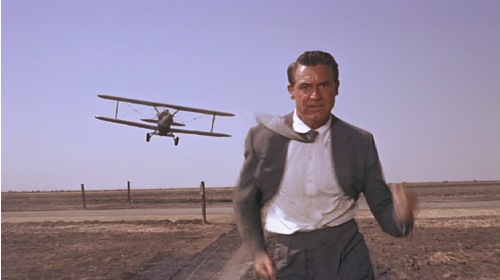
This is the North by North West Poster. It grabs peoples attention as it shows Cary Grant, who was one of the most successful actors of his time. As well as Alfred Hitchcock as director who was known as one of the best directors in the world. It was made in 1959 by Hitchcock.The picture shows Cary Grant with an airplane behind him, which leaves people mysterious and wanting to watch what is going to happen


Alfred Hitchcock- The director, was named "The Master of Suspense" and pioneered many techniques in the suspense and psychological thriller genres. He was born in August 13 1899 in Leytonstone, East London and died in April 29, 1980 in Bel-Air Los Angelees. 

In all of his films Hitchcock planned every scene visually in advance. Before shooting Hitchcock has learned all the dialogue and rarely needs to look at a script. When directing Hitchcock never looked at his camera. The intricate plot was written by Ernest Lehman.North By NorthWest gets 8.5/10 ratings, which was clearly a big success.


 - This shows us the trailer of North By NorthWest. 

The Trailer shows us all the interesting and intense scenes from North By NorthWest, such as the shooting and Eva Saint hanging off the cliff in the final scene, which made people want to watch the film to see how they got to the situations and if they survive. It appealed to its audience because it showed a lot of Cary Grant who was a very famous actor at that time, it also showed a lot of its fast passing action scenes such as the shooting.

Now You See Me Trailer- https://www.youtube.com/watch?v=4OtM9j2lcUA  


This is a modern thriller movie made in 2013, compared to North By NorthWest it is more appealing to the audience of today, as it has better sound affects and has used non-dietetic sounds. North By North West has also used some non-dietetic sounds however it is more dull and contrapuntal and mainly a voice over. 

Examples of where Hitchcock used high amount of suspense is the crop duster and the shooting scene  scenes.  

Crop Duster scene. This is also the fantasy Scene.  https://www.youtube.com/watch?v=GbpUcAI86MY


  Alfred Hitchcock builds up the tension slowly and slowly by using a red herring at the side walk  scene, and making the audience think that Roger is sent there to be shot. When we see the black limosine drive up we are expected to think that it is George Kaplan, but when it drives past that idea is slowly erased. Then a car pulls up and a man steps out of the car, now the audience are certain that this is Kaplan and the tension builds, as Roger goes up to this man we discover that he is only waiting for the bus and is not Kaplan. Once again the audience are confused at what will happen next and where exactly Kaplan is. The man then mentions "that's funny. That planes dusting crops where there aint no crops." The audience keep this in mind as the plane may hold a key point in this scene. And the suspense and Tension begins to build as we move onto the Crop Duster scene. The audience already know that if Mr.Thornhill was going to be murdered, he would have been shot and not taken to a remote place and killed by a crop duster. Conversingly, it makes it more exciting and builds up more and more tension as the auidence wonder what is going to happen next...

Hitctcock expresses his thoughts and talks though the scene in detail in his interview. -  https://www.youtube.com/watch?v=ig_7Es1h0eQ 

Hitchcock believed the stress on the visual makes cinema accessible in different languages. This is because there isn't much dialogue taken place after the man leaves to get on the bus. In addition, if Mr.Thornhill was going to be murdered he would be shot, not get a crop duster to kill him, which builds up the tension and suspense as the audience wait for what is going to happen next. Another example of suspense is where Mr.Thornhill is driving while drunk in the car, it leaves the audience at edge wondering whether he is going to make it out of there alive. 

Hitchcock likes the subjective view point close ups on a face, then what the person is looking at and then close up again as the character to reacts to what has been seen. Hitchcock said he wants to transfer the menace that appears in screen into the mind of the audience.


Drunk Driving Scene- https://www.youtube.com/watch?v=qNsNlCPXGiA
Shooting scenehttps://www.youtube.com/watch?v=sAhKLfzDHcI

Examples of Cliff Hangers include the Mt,Rushmore Scene
Mt. Rushmore scenehttps://www.youtube.com/watch?v=4zr_zL_T3g8


https://www.youtube.com/watch?v=dl0JcK4-Dx0 - Auction Scene

At the start of the Auction Scene we see Mr.Vamdamme stroking Eve Kendall's Back and slowly moving to her neck. At first we seem this is some sort of sexual tension, but looking closely it seems to appear as if he may be chocking her. This suggests Mr. Vandamne's dangerous and mysterious side. Also Alfred uses suspense and tension at the end of the auction scene when Mr. Thornhill pretends to be drunk to cause disorder and so that he doesn't have to face Mr. Vandamme's assiosaites. 


https://www.youtube.com/watch?v=4bdfenrWYTs- The ending of the Auction Scene, we see how shocked the other characters are by Thornhill's behavior. This is because they are all middle/upper class and Mr.Thornhill's behavior would be considered lower class and not elegant, or not how higher class people should act.

Hitchcock beliefs 


  • Mt. Rushmore is a symbol of order. Hitchcock throws in disorder.

  • Hitchcock said that audiences often need relief from suspense - a change of pace. e.g a joke. An Example of this is where Roger gets kidnapped and is in the car and makes a joke.

  • He states " A thriller is a villain driven plot, whereby he presents obstacles the hero must overcome".

  • The MacGuffin is a plot or device in the form of some goal or desired object, this is often where the audience don't care about. In North by NorthWest the MacGuffin is the microfilm. In the end Eve and Roger get the microfilm but all the audience care about is what happens to Mr.Vandanm and if they survive!


North by North West Follows the Classic Hollywood Narrative - This is where events are in chronological order, and have a few sub-plots.
North By NorthWest also follows narrative theory of 5 stages

1. The equilibrium is when Roger is having some drinks with his friends at the bar.

2. The disruption of the order by that event is where Roger gets mistaken as Kaplan and gets kidnapped by Mr. Vandame's associates.

3. Roger than realizes what is going on, and that he has been mistaken for someone who he isn't.

4. An attempt to repair the damage is where he tries to defeat Vandame and get Eve to not go on the plane.

5. The new equilibrium is where him and Eve defeat the villains and get married.


Difference in groups in
 NBNW

In North by North West different groups are presented stereotypical and expected. For example; Men and Women,
In NBNW Men are represented as powerful strong meaningful characters. The villain is Mr. Vandamme and the hero is Mr. Thornhill who are both men. 
Whereas the only main female character in this film is represented as weak, powerless and controlled. This is Eve Kendall, she is being controlled and ordered to be Mr. Vandamme's mistress and to wheel Roger into his plans. Any actions Eve make is not really noticed or meaningful due to her position. 

Furthermore, the working class mans uniform fit Mr. Thonhill perfectly even though Roger is tall and much bigger than him, which doesn't make sense. 

In addition, another difference between groups are the upper/middle class and lower/working class people. The middle/upper class people have the say and are in charge, where as the lower class don't have much say. In north by northwest, the working class man on the train sells his uniform for money, which shows the typical expectation for working class people; which is that they will do anything for some extra cash. 


Laura Mulvey's ; Male Gaze Theory

Laura's theory was that in cinema, the camera looks like a man. Meaning that it has the same views and thoughts as a man would have. This can also apply to North by North West, as Eve is viewed as the objects of male erotic desire in the film and also to the audience. 
In addition, Laura said that Women do not have agency and do not move the plot forward, therefore their actions are meaningless, just like Eve Kendall in North by North West. Eve is told to chat up Roger Thornhill and doesn't do anything from her own intentions. Eve is also used as a sex object. 

Laura's theory also continues into saying that; 
  • The audience is forced to identify with the male gaze whether they know it or not. 
  • Cinema reflects patriarchal society.
  • Patriarchy and Phallocenrism is linked to Phallus, which shows a symbol of power. For example. Guns are used to show power and control.
  • North by North West and No Where To Run  by Claude Van Damme are both key examples of this,


Monday, 22 September 2014

Media Theory - Barthes and Strauss


Barthes and Strauss 


Roland Barthes came up with Enigma meaning a mystery that takes place in each film. Barthes named it 'Enigma Codes' 

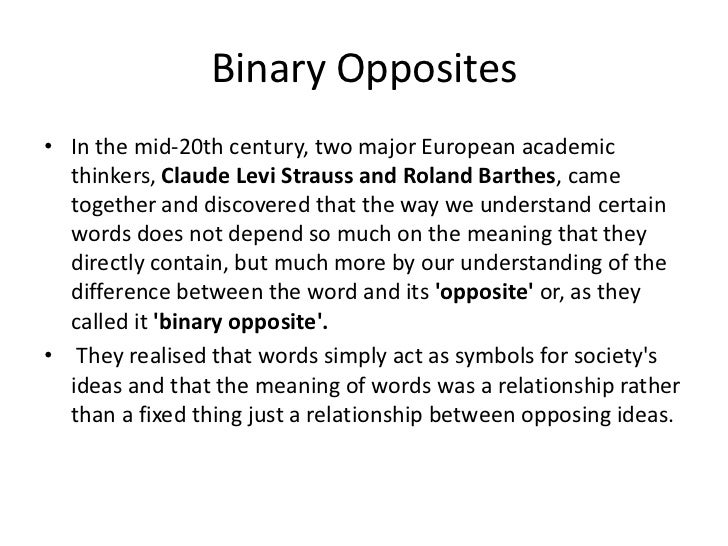
Levi Strauss came up with the idea that their is always some sort of heroes and villains in a film. Levi Strauss named it 'Binary Opposites' 


Todorov's Narrative Theory 


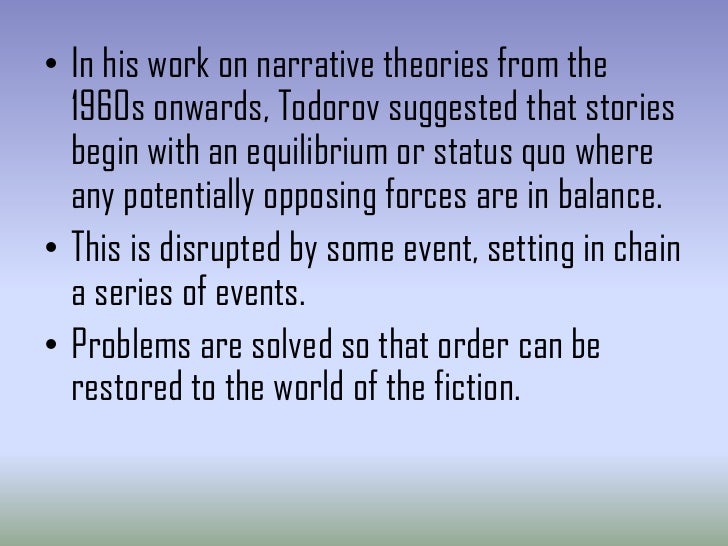
In 1969 Todorov produced a theory which he believed could be applied to any film. Todorov believed that all films followed the same narrative pattern though various stages. 


Todorov's 5 stages (5 stages narrative can progress through)


1. A state of equilibrium (Where everything is all as it should be)

2. A disruption of that order by an event. 

3. A recognition that the disorder has occurred. 

4. An attempt to repair the damage of the disruption.

5. A return or restoration of a New equilibrium that has been put into place.

An Example of some thriller films that follow these 5 stages of narrative are Taken and Die Hard. 

* insert a trailer of taken and die hard* 

*insert a picture of taken and die hard*


Die Hard's Narrative Progress


1.
Die hards narrative stages starts at the equilibrium where John is coming home for Christmas and the environment is normal and as it should be.

2.
The disruption is that a team of terrorists want to take over the nakatomi building where he is hosting and where is Wife is also at tenting.

3.
 He then recognises that their is a disorder. As he isn't in the room when he terrorist come in so he chooses to move up the building. 

4.
John then takes an attempt to repair the damage of the disruption by calling in the police which fails and then has to result in one death. 

5.
The new equilibruim is restored when police collect John. his family and other members of the hostages out of the building and leave in a police car. 


Traditional Hollywood Narrative Structure - 3 Acts (linear) 


The Traditional Hollywood Narrative Structure consist of The Three Act Structure 

The Three Act Structure is the typical Hollywood Narrative (25% time )/confrontation (50%)/climax (Final 25% of the rest of the film time). 

Linear -(chronological), few, if any, sub plots, tendency towards closure at the end of the film.


Vladimir Propp


Vladimir Propp came up with character types. He analysed traditional folk stories. 

He said that Hero/Villain/Helper/Donor/Father/Dispatcher/Princess  can all be one. and one character can perform like more than one role. 


Friday, 19 September 2014

Genre and Narrative


Key Film Language 

The key Technical components of a film can be divided into key categories;

Marco Elements and Micro Elements. Macro Elements refers to Genre and Narrative.


Genre
Genre refers to a cateory of media products that classify as being organised.

There are many types of Genres, these include;
 Horror, Comedy, Thriller, Drama, Action, Romance, Adventure,Sci-FI, Musicals, Western, Fantasy, Historical, Short Films and Documentary.

GUESS THE GENRE ...


    ? ?


 ? ?

 ? ?

 ? ?

 ? ?

  ? ?

 ? ?


Narrative 

Narrative refers to the way a story is organised. A sequence of events, often referred to as the plot.

Narrative Structure

A Narrative Structure is the way those events are revealed to the audience.


Linear Narrative  

Linear Narrative is the sequence of events are shown in the order that they place beginning, middle and end. This is the most popular form of narrative structure. E.G. Road Train, Drag Me To Hell and The Call. http://www.imdb.com/video/wab/vi3122791449/   http://www.imdb.com/title/tt1127180/?ref_=nv_sr_1 http://www.imdb.com/title/tt1911644/?ref_=nv_sr_1

Non-Linear Narrative

Non-Linear Narrative is the sequence of events that are revealed out of the expected order E.g Pulp Fiction, Momento and The Walking Dead. http://www.imdb.com/video/imdb/vi164666905/  http://www.imdb.com/video/screenplay/vi1368785177/  http://www.imdb.com/title/tt1520211/?ref_=nv_sr_1